
HERITAGE
1796 High Light fitted with "eleven Argand burners set in the focus of silvered reflectors" (p102 Lights of East Anglia by Neville Long, 1983)
Added: 23 September, 20231778 A 'spangle light' was tested for one night on Lowestoft Low Light by several Trinity Elders sailing out to sea. The design was never permanently used. A many-signed letter said the new light was 'constant, certain and regular', and seen from a greater distance than the coalfired light. In February 1779 a 'small reflector was ordered to be fixed to a triangle or beacon'. In September 1779 '...a Mr Smith was paid £6.5.o for a plated reflector, lamp and fountain'.
Added: 23 September, 2023
Huge storm. On the coast between Yarmouth and Southwold thirty ships and 200 lives were lost. Eighteen vessels washed up on Lowestoft beaches.
Added: 23 September, 2023
1867 A completely new Lowestoft Low Light, made of wrought iron. It was designed to be moveable.
Added: 23 September, 2023As the sandbanks shifted and Pakefield lighthouse was declared redundant and closed in 1864. The lighthouse’s 10m high tower has since been used as a war-time oservation post, store-room and holiday camp darkroom.
Added: 23 September, 2023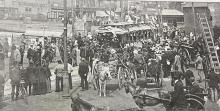
Early in 1903 construction started of the Tramway from Florence Road in Pakefield to Yarmouth Road in north Lowestoft. A spur was built along Denmark Road to the tramshed (still there)in Rotterdam Road. It was 3 ft 6 ins gauge, with the rails imported from Germany.
Added: 23 September, 20231974 the High Light is now fully automatic.
Added: 23 September, 2023
1923 Low Light extinguished, as the Stanford Channel was no more.
Added: 23 September, 2023